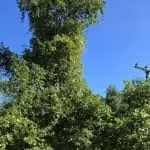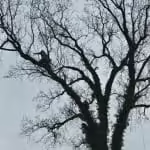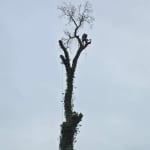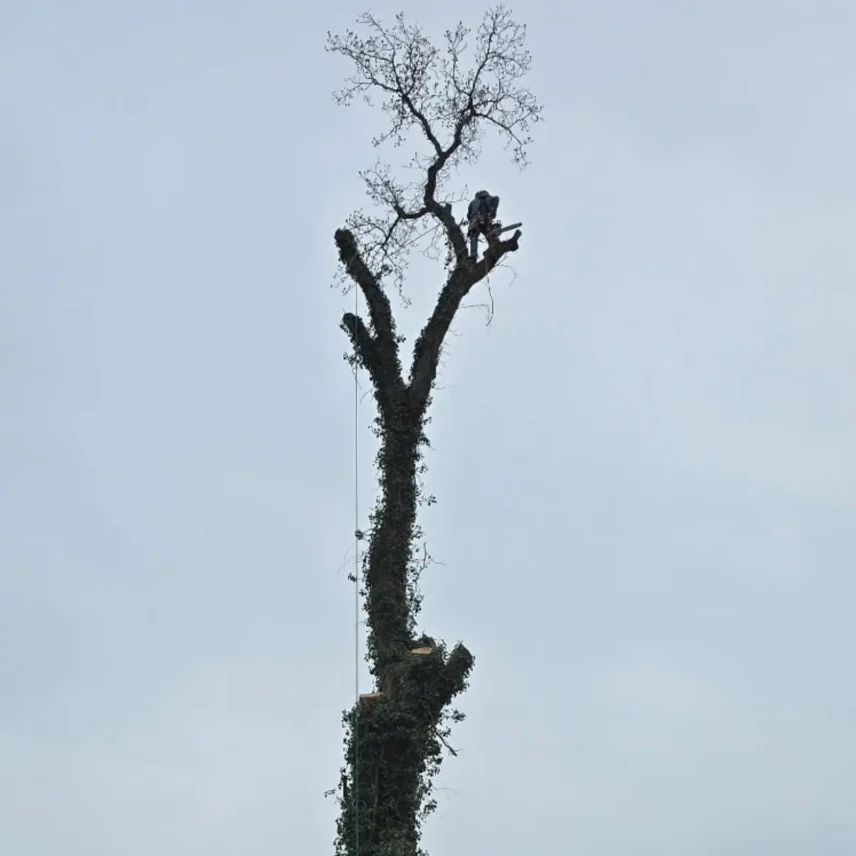
A tree that loses leaves early or develops a few bare branches may be in decline, but that symptom alone does not prove the tree is dead. Weather, seasonal dormancy, root disturbance, insects, disease, and temporary water stress can produce similar changes. Learning how to identify dead or dying trees begins with looking for patterns across the entire tree, from the canopy to the roots.
For Northern Virginia property owners, the location of the tree matters as much as its condition. A declining tree in an open field presents a different concern than one beside a home, driveway, fence, barn, play area, or utility line. A visual check can help you recognize warning signs, but a professional tree assessment is the safest way to determine the cause, structural stability, and appropriate next step.
Why Tree Decline Is Not Always Easy to Diagnose
Trees often respond to different problems in the same way. Thin foliage, yellow leaves, short twig growth, and dead branches can result from drought, excess water, compacted soil, root injury, disease, or pest pressure. More than one issue may also be affecting the tree at the same time.
The International Society of Arboriculture notes that symptoms such as discolored leaves, dead branches, and early leaf drop may have a simple cause or several underlying causes that require longer-term care. Virginia Cooperative Extension likewise recommends collecting information about the whole tree and its site before making tree-care decisions. That broader view helps prevent a temporary problem from being mistaken for death and keeps a serious structural defect from being dismissed as normal aging.
One visible symptom is a reason to look closer from a safe distance. A combination of symptoms, a change that is getting worse, or a defect near people and structures is a reason to arrange an on-site evaluation.
Dead, Dying, Dormant, or Temporarily Stressed?
These terms describe different conditions, and they should not be used interchangeably.
A dead tree
A dead tree no longer has living tissue capable of producing new growth. It will not recover. If you are trying to determine how to tell if a tree is dead, look for several dead tree warning signs rather than relying on leaf loss alone. Depending on how long it has been dead, it may show a bare canopy during the growing season, widespread brittle branches, loosening bark, decay, or missing buds. Some dead trees retain dry leaves or bark for a period, so appearance alone can still be misleading.
A dying tree
A dying tree is alive but experiencing progressive decline. Dieback may begin at branch tips or in one part of the canopy and expand over time. The outcome depends on the cause, how advanced the problem is, and whether the trunk and roots remain structurally sound. Some declining trees can be monitored, pruned, or treated. Others cannot be made acceptably safe.
A dormant tree
Dormancy is a normal seasonal pause in growth. Deciduous trees naturally lose their leaves and remain bare through winter, so a leafless tree in January is not automatically dead. Bud-break timing also varies by species and site. A tree that appears late compared with one nearby may simply be a different species or growing in a cooler, shadier location.
A temporarily stressed tree
A stressed tree may have wilted leaves, early color change, reduced growth, or scattered dieback after drought, excessive rain, soil disturbance, transplanting, or root-zone compaction. Stress can improve when the underlying condition is corrected, but prolonged stress can make a tree more vulnerable to secondary insects, disease, and decay.
Timing provides useful context. Compare the tree with its own appearance in previous seasons and, when possible, with healthy trees of the same species nearby. Avoid comparing unrelated species because their leaf-out, fall color, and dormancy schedules may differ.
How to Identify Dead or Dying Trees by the Canopy
The canopy often shows decline before the cause is obvious at ground level. Stand far enough away to view the entire crown. Look for distribution and progression rather than one isolated twig.
Possible signs of a dying tree include:
- A canopy that is noticeably thinner than it was in prior growing seasons
- Large sections that remain bare after the tree should have leafed out
- Dieback beginning at the tips and moving into larger branches
- Leaves that are unusually small, pale, scorched, wilted, or sparse
- Premature fall color or leaf loss well before similar trees nearby
- Extensive browning or needle loss on an evergreen
Scattered dead twigs can occur after a difficult season and do not necessarily mean the whole tree is dying. Concern increases when several major limbs are affected, the upper crown continues to thin, or the decline appears alongside trunk, root, fungal, or insect warning signs.
What Brittle Branches and Deadwood May Indicate
Dead branches lose flexibility and eventually become brittle. They may have peeling bark, missing buds, or fine twigs that have already fallen away. Larger dead limbs can remain suspended in the canopy even after their attachment has weakened.
Do not pull, shake, or try to snap a questionable branch. Never stand beneath it to inspect it. A branch can be dead while the rest of the tree remains alive, and professional pruning may be enough when the trunk, roots, and remaining crown are stable. Premier Tree & Landscaping’s tree trimming service includes the controlled removal of dead, broken, and hanging branches when trimming is the appropriate recommendation.
Repeated branch loss, widespread deadwood, or major limbs dying back toward the trunk points to a larger problem that deserves evaluation.
Bark, Trunk, and Decay Warning Signs
Bark naturally varies by species. Some healthy trees have smooth bark, while others develop plates, ridges, or exfoliating patches as they mature. The warning sign is usually a new or expanding change, especially when it exposes damaged wood or occurs with canopy decline.
Watch for:
- Large areas of bark that are loose, missing, or separating from dead wood
- Deep or fresh cracks in the trunk or at a major branch union
- A trunk that is splitting into two moving sections
- Sunken, discolored, or callused areas that may be cankers
- Open cavities, old wounds, soft-looking wood, or crumbling material
- Bulges or unusual growth around a crack, wound, or hollow
- Dark staining or fluid coming from a damaged area
Virginia Cooperative Extension describes some cankers as sunken or darkened areas, sometimes surrounded by wound wood, with bark that may peel away. Still, a canker has to be interpreted in context. Its position, depth, progression, and effect on the tree cannot be determined reliably from a distant photo alone.
A cavity also does not automatically mean removal. Trees can remain standing with hollows because living wood grows around older damage. The key questions are how much sound wood remains, whether cracks are present, and what could be struck if the trunk or a major limb failed. Do not probe a cavity, peel bark, drill the trunk, or strike the tree to test for a hollow sound. Those actions can damage living tissue and place you too close to an unstable tree.
Mushrooms, Conks, and Other Fungal Growth
Mushrooms growing in lawn soil or mulch may be decomposing buried organic material and may not involve the tree. Fungal fruiting bodies attached to the trunk, root flare, exposed roots, or a major branch deserve more attention because some fungi decay wood.
Shelf-like conks, clusters that repeatedly return near the base, or fungal growth emerging from a wound may indicate internal decay. The visible growth does not show how far the decay extends, how fast it is progressing, or how much structural strength remains. Identification of the fungus and evaluation of the affected wood are needed before deciding whether the tree should be monitored, pruned, treated, or removed.
The USDA Forest Service includes conks, cavities, cracks, cankers, dead branches, and root damage among common indicators used in hazard-tree evaluation. These are indicators of a possible defect, not stand-alone proof that every affected tree will fail.
Insect Activity Can Be a Clue, Not a Complete Diagnosis
Small holes in bark, loose bark, winding galleries, or sawdust-like material can point to wood-boring insects. The fine debris made by insects is often called frass. Virginia Cooperative Extension explains that some borers pack their tunnels with sawdust-like frass and may attack stressed, dying, or recently dead hardwoods.
Look from a safe distance for clusters of holes, repeated debris at the base, or bark that has loosened around an affected area. Insect activity may be the primary problem, or it may be taking advantage of a tree already weakened by another condition. Hole shape and size can help identify a pest, but homeowners should not remove bark or cut into a trunk to search for galleries.
If insect signs appear together with canopy dieback, dead branches, or bark loss, arrange a professional evaluation rather than applying a general pesticide without a diagnosis.
Root Damage and Changes at the Base of the Tree
Roots supply water and nutrients and anchor the tree. A tree can maintain a green canopy for some time after serious root injury, which is why changes around the base should not be ignored.
Look for visible conditions such as severed roots after trenching, roots damaged by vehicles or equipment, decay on exposed roots, erosion that has removed supporting soil, or repeated standing water around the trunk. Construction, grade changes, new pavement, and soil compaction can also affect roots even when the injury is not visible.
Saturated ground is especially relevant after extended rain in Virginia. Wet soil alone does not prove a tree is unstable, but it can reduce root anchorage. A new lean combined with lifted, cracked, or mounded soil on the opposite side of the trunk can indicate movement of the root plate and requires immediate attention.
Signs That Require Immediate Attention
Tree health and tree risk are related, but they are not identical. A live tree can have a dangerous structural defect, while a dead tree in an isolated location may not create the same immediate exposure as one beside a house.
Keep people and pets away and request urgent help if you see:
- A tree that developed a sudden or increasing lean
- Freshly lifted soil, root-plate movement, or widening cracks around the base
- A trunk or major branch that is actively splitting
- A large broken limb hanging over an occupied or frequently used area
- A tree or branch resting on a home, vehicle, driveway, or other structure
- Any part of a tree contacting a utility line
If power lines are involved, do not approach the tree or anything it touches. Contact the utility company first and call emergency services if there is an immediate threat to life or fire risk. For other urgent tree hazards, Premier Tree & Landscaping provides 24/7 emergency tree service when conditions allow safe access.
Safe Visual Checks You Can Make From the Ground
A homeowner’s check should be observational. You are gathering useful information, not testing the tree’s strength.
Start from a distance and view the tree from more than one side if you can do so without entering a drop zone or crossing a restricted area. Use your phone camera or binoculars to look at the upper crown. Note which sections are bare and whether deadwood is concentrated on one side.
Then review the tree’s recent history. Did the change follow a storm, excavation, driveway work, flooding, drought, or an injury to the trunk? Take dated photos from the same locations so you can see whether a lean, crack, fungal growth, or canopy gap is changing.
Also identify possible targets within reach of the tree or its branches. A defect becomes more urgent when failure could affect people, buildings, parked vehicles, fences, roads, or access points.
Do not:
- Climb the tree or use a ladder for a closer look
- Stand beneath dead, cracked, or hanging limbs
- Cut a branch to check whether the inside is green
- Peel bark, probe cavities, drill, or strike the trunk
- Push, pull, or shake the tree
- Attempt work near utility lines
These actions can trigger falling material, expose you to stored tension in damaged wood, or create a new wound.
The Right Response May Be Monitoring, Pruning, Treatment, or Removal
The appropriate recommendation depends on the diagnosis and the level of risk.
Monitoring may be reasonable when symptoms are minor, seasonal, or stable and there are no significant structural concerns. Dated photos and periodic observations can show whether the tree recovers or continues to decline.
Pruning may be appropriate when decline is limited to specific branches and the rest of the tree is structurally sound. Proper cuts can remove dead or damaged wood without sacrificing the entire tree. The company’s professional pruning service can be considered when targeted branch work is recommended.
Treatment or changes in care may help when the cause is identifiable and the tree has enough healthy structure and vitality to respond. The remedy might involve addressing soil, moisture, pest, disease, or root-zone conditions, depending on the diagnosis.
Removal becomes appropriate when a tree is dead, decline is irreversible, or structural defects create an unacceptable risk that cannot be reduced reasonably. If evaluation shows that removal is necessary, learn how the company plans controlled removal around nearby structures and landscaping.
The ISA outlines several possible risk-reduction options, including moving a target, pruning defective branches, providing routine care, using supplemental support in suitable cases, or removing a tree when the risk is unacceptable. This is why the presence of one mushroom, cavity, dead limb, or thin patch should not be treated as an automatic removal decision.
When to Schedule a Professional Tree Evaluation
Schedule an on-site evaluation when symptoms affect more than one part of the tree, continue across seasons, or cannot be viewed safely. It is also wise to call after major storm damage, construction near the root zone, a new fungal growth at the base, repeated branch failure, or combined insect and canopy symptoms.
Location should lower your threshold for requesting help. A questionable tree beside a house, driveway, walkway, play area, barn, fence, or neighboring property needs a clearer assessment than a tree with no likely target nearby.
Premier Tree & Landscaping is based in Castleton and serves properties across Northern and Central Virginia communities, including Culpeper, Fauquier, Madison, Greene, Orange, Rappahannock, Prince William, Stafford, Spotsylvania, and King George counties. Its arborist-led evaluations consider tree structure, surrounding conditions, access, and realistic outcomes before work is recommended.
If you have noticed canopy decline, deadwood, trunk damage, fungal growth, root movement, or another change you cannot explain, request a free on-site estimate or call (540) 264-9008. A professional evaluation can help determine whether the tree should be monitored, pruned, treated, or removed and whether the situation requires immediate action.