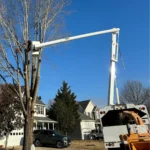
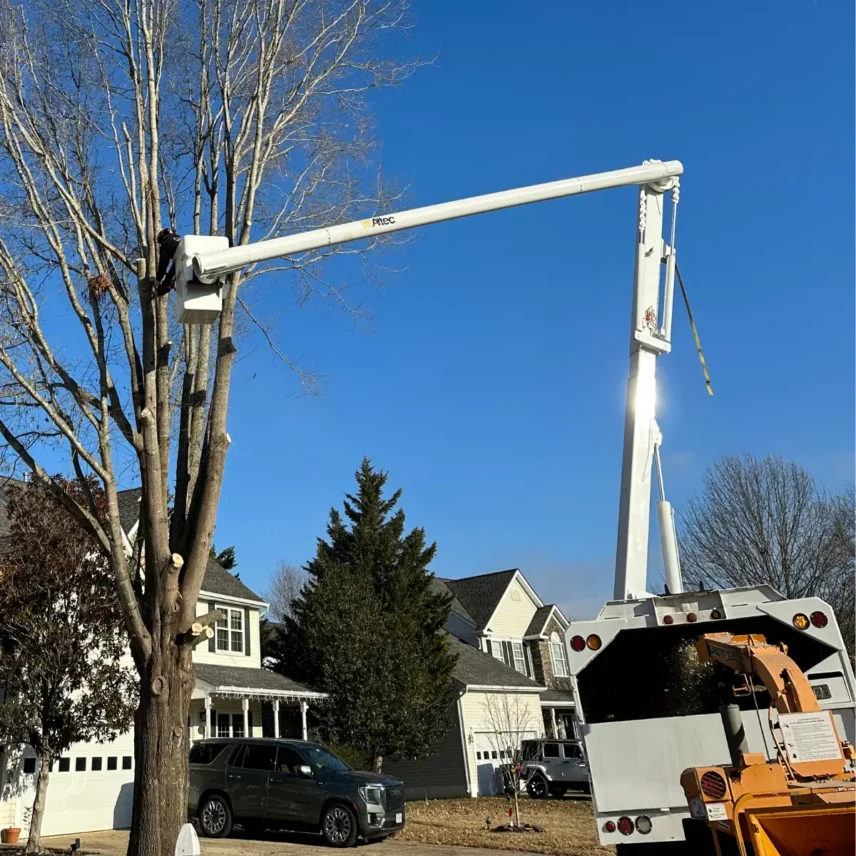
A tree growing close to a house is harder to remove because the structure limits working space and reduces the room for error. The tree’s size, lean, branch spread, and overall condition all shape how the job can safely be done.
We look at every house-adjacent removal as its own project. No two trees sit the same distance from a roofline, and no two properties offer the same access, so the plan has to match the site in front of us.
A tree standing in an open field can often be felled in one direction with little concern for what it might strike. Once a roof, deck, fence, or driveway sits within range, that option usually disappears. We then have to weigh the tree’s lean, weight distribution, and branch structure against the available space before deciding how sections will come down.
Being close to a house does not automatically mean a crane is required. Some house-adjacent removals are handled with careful sectional cutting and rope work alone, while others need heavier rigging or crane-assisted removal because of size, access, or risk. That decision comes from the on-site evaluation, not from proximity by itself.
Does Every Tree Close to a House Need to Be Removed?
No. Proximity alone does not mean a tree has to come down, and a healthy tree near a house may only need trimming to manage clearance. We look at the tree’s health, structure, and the realistic consequences of leaving it in place before recommending removal.
An evaluation typically considers:
- The tree’s overall health and any visible defects
- How close branches or the trunk sit to the house, roof, or utilities
- What could be damaged if a limb or the tree failed
- Whether pruning can resolve the concern instead of removal
If a tree is structurally sound and the clearance issue involves a few overextended limbs, professional tree trimming may be the more appropriate and less disruptive option. Removal becomes the recommendation when the tree’s condition or position creates a risk that pruning cannot reasonably address.
How Does the Tree’s Condition Affect the Removal Plan?
A tree’s condition determines how predictable it will behave during removal, and that predictability shapes every decision that follows. Decay, cracks, cavities, dead branches, root problems, or a recent lean can all make a tree respond differently than expected once cutting begins.
A tree can look healthy from the ground and still carry structural defects underneath. Green leaves do not rule out internal decay, weak branch unions, or root damage, which is why a visual assessment during an on-site evaluation matters more than appearance alone. We do not diagnose internal decay without a proper look at the tree itself.
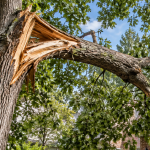
Storm-damaged trees deserve particular caution near a house. A split trunk or a sudden lean can mean the tree is no longer stable enough to support certain removal techniques, which changes the plan entirely.
Why Does a Limited Drop Zone Matter?
The drop zone is the open area where cut branches and trunk sections can be lowered or placed safely, and a smaller drop zone means less margin for error. Houses, garages, sheds, driveways, fences, pools, septic fields, and landscaping all shrink that usable space.
When a house sits close to the tree, large sections cannot simply be dropped nearby the way they might be in an open yard. Every piece has to be sized, directed, and controlled so it lands where intended rather than where gravity would otherwise take it.
This is one of the biggest differences between an open-area removal and a house-adjacent one. The available space, not just the tree’s size, often determines whether the job can be done with basic techniques or requires more controlled methods.
When Is Sectional Tree Removal Necessary?
Sectional removal becomes necessary when there is not enough open space to fell a tree in one piece without risking nearby structures. Instead of taking the tree down as a whole, it is dismantled in smaller, controlled pieces from the top down.
This approach lets a tree be removed piece by piece even when a house, garage, or fence sits directly in the fall path. Each section is sized and lowered according to the space available and the load it represents, which keeps the surrounding property protected throughout the job. We are not going to walk through cutting sequences or rigging setups here, since that kind of work should be left to a trained crew rather than attempted independently.
When Might Rigging or Crane Assistance Be Used?
Rigging systems or crane-assisted removal may be used when a tree’s size, position, or load makes sectional hand-lowering impractical or unsafe. The right method depends on the tree’s structure, the site layout, and access, not on a fixed rule tied to proximity alone.
Rigging uses ropes, pulleys, and controlled lowering to guide cut sections away from targets like a roof or deck. Crane-assisted removal can lift and place large sections directly, which is sometimes useful when access is tight or a tree is too large or unstable for standard rigging. Neither method is automatically required, faster, or safer in every case. The choice comes from a professional assessment of the specific tree and site.
How Do the Roof and Exterior Features Affect Removal?
Rooflines, gutters, chimneys, siding, decks, porches, and HVAC equipment all shape the work zone and influence how sections are lowered. Anything mounted on or attached to the house becomes a potential target that has to be accounted for in the plan.
A tree overhanging a roof edge, for example, may require a different lowering angle than one near a flat side wall. We do not use a fixed distance rule to decide whether a tree is too close to a structure. Instead, the specific layout of the house and the tree’s canopy determine how carefully each section needs to be handled.
Why Is Equipment Access Important?
Equipment access determines what tools and methods can realistically be used on a given property, and limited access can rule out certain approaches entirely. Gates, narrow driveways, slopes, retaining walls, landscaping beds, and overhead obstacles all affect where equipment can be placed.
Access has to work in two directions. We need a way to reach the tree itself, and we also need a route for moving cut logs and debris off the property once the work is done. A tight side yard or a driveway shared with a neighboring property can change the entire logistics of a job.
How Do Ground Conditions Complicate the Job?
Ground conditions affect how safely and effectively equipment can be used near a house, especially after recent rain. Saturated soil, slopes, soft lawn areas, and poor drainage can all limit where heavy equipment can safely operate.
We cannot promise that professional equipment will leave absolutely no trace on the property. What careful planning can do is reduce unnecessary disturbance by choosing routes and placement that account for current ground conditions rather than ignoring them. Scheduling may also shift if the ground needs time to firm up after heavy rain, which is common across Northern Virginia properties during wet stretches.
What Happens When Utility Lines Are Nearby?
Overhead and underground utilities require additional planning before any house-adjacent removal near them can proceed. A tree contacting or threatening an energized line changes the job from a standard removal into one that needs utility coordination first.
If a line is down or damaged, stay away from the area and contact your utility provider immediately rather than approaching it. We do not ask homeowners to determine whether a line is energized, and an ordinary tree crew should never work on energized distribution lines without the qualifications and coordination that kind of work requires. Our trees near power lines resource covers this responsibility in more detail if a tree on your property is involved with utility conflicts specifically.
What Other Property Features Must Be Identified?
Less-visible site features can complicate a removal just as much as what is easily seen from the driveway. These need to be identified before work begins, not discovered partway through the job.
Common features that affect planning include:
- Underground utilities and irrigation lines
- Septic systems, wells, and drain fields
- Invisible pet fences and landscape lighting
- Neighboring property lines, fences, and retaining walls
Tell us about any known underground or private systems during the estimate. That information helps shape equipment routes and placement before the crew ever arrives on site.
How Does a Tree’s Lean Affect the Removal?
A tree’s lean changes how weight is distributed and which direction forces act on it during removal, which matters more, not less, when a house sits nearby. A natural lean the tree developed gradually over years behaves differently than a lean that appeared suddenly.
A sudden shift, lifted soil around the root ball, or a lean that developed after a storm suggests the tree’s root system may already be compromised. That distinction affects the removal approach, but we are not going to describe cutting or felling techniques for a leaning tree here. That decision belongs with a trained crew evaluating the tree in person.
Is a Dead Tree More Difficult to Remove Near a House?
A dead or severely decayed tree can be more difficult to remove near a house because brittle wood is less reliable for climbing, anchoring, or rigging. Wood that has lost moisture and structural integrity can fail in ways a living tree would not.
Not every dead tree requires the same equipment or approach. Some dead trees are still structurally sound enough for standard techniques, while others need a more conservative plan built around the wood’s condition. That determination comes from an on-site evaluation rather than a general assumption based on the tree being dead.
When Does Removal Near a House Become an Emergency?
Removal near a house becomes an emergency when a tree has fallen onto a structure, developed a sudden lean, split, uprooted, dropped hanging limbs, or come into contact with utility lines. These situations carry an immediate risk to people and property that should not wait for a scheduled appointment.
Keep people and pets away from the affected area until it has been assessed. If electrical lines are involved in any way, contact the utility provider before approaching the tree or the area around it. Our emergency tree service covers what to expect when a situation needs an urgent response rather than a routine estimate.
What Is Included in a Tree Removal Estimate?
A professional estimate should define the specific scope of the planned work in writing, not just a general description of the job. That written scope is what protects both sides once the crew is on site.
An estimate for a house-adjacent removal should typically address:
- The tree or sections being removed and the planned method
- Equipment access and protection for surrounding property
- Debris handling and expected site condition afterward
- Stump-grinding options, and any permit or utility coordination needed
Not every item applies to every job, and not everything is automatically included unless it is written into the scope. Confirm the details in writing before work begins so expectations are clear on both sides.
What Affects the Cost of Removing a Tree Near a House?
Cost depends on a combination of the tree’s size and condition, the site’s access, and how much protection the job requires, not on a single flat factor. A tree with straightforward access costs differently than one requiring rigging around a roofline.
Factors that typically influence pricing include:
- Tree height, trunk diameter, and overall condition
- Proximity to the house and other nearby structures
- Available drop zone and required equipment or rigging
- Site access, ground conditions, and debris volume
- Whether stump grinding is added and whether the job is emergency or scheduled work
Because these factors vary so much from property to property, an on-site evaluation is usually necessary for an accurate quote. If a project involves clearing several trees rather than removing one near the house, that broader scope may fall under land clearing instead of a single-tree removal.
How Long Does Tree Removal Near a House Take?
There is no universal timeline for a house-adjacent removal, since duration depends on the tree’s size and condition, the site’s access, weather, and how much protection nearby structures require. A straightforward removal with good access takes far less time than one requiring sectional dismantling and rigging.
Debris handling and cleanup also factor into the overall timeline. We walk through a realistic timeframe for your specific property during the on-site evaluation rather than quoting a fixed number that may not hold up once work begins.
What Should Homeowners Do Before the Crew Arrives?
A little preparation helps the crew work efficiently and keeps the property protected during a house-adjacent removal. Most of what is needed involves clearing the work area and confirming details ahead of time.
Helpful steps before the scheduled day include:
- Moving vehicles away from the driveway and work area
- Removing movable furniture, decorations, or planters nearby
- Keeping children and pets indoors or away from the site
- Confirming access points and reviewing the written scope in advance
- Pointing out irrigation lines or private utilities the crew should know about
Do not attempt to cut branches, climb the tree, or move unstable storm debris yourself. Leave anything involving the tree itself to the crew handling the job.
What Happens to the Stump After Removal?
Tree removal and stump grinding are generally separate parts of the project unless the written estimate states otherwise. Removing the tree addresses the immediate hazard, while the stump is a separate decision.
A stump’s location near a house, walkway, utility line, or planned construction often influences whether grinding makes sense right away or can wait. Our stump grinding page covers what that process involves and when it is typically recommended.
Why Does Cleanup Matter After a House-Adjacent Removal?
Cleanup matters because branches, logs, sawdust, and equipment traffic all need careful management around an occupied property. A yard used as a work zone during the job still has to function as a yard afterward.
Equipment routes across lawns, planting beds, or gravel driveways should be planned with the property’s daily use in mind. The expected cleanup and final site condition should be part of the written scope discussed during the estimate, not something assumed after the fact.
Tree Removal Near a House in Northern Virginia
Removing a tree close to a house takes more than cutting it down. It takes a plan built around the tree’s condition, the available space, and the structures and utilities around it.
We provide tree removal throughout Northern Virginia and the Northern Neck, working on properties ranging from established neighborhoods with tight access to rural properties with barns, septic systems, and long driveways. Mature hardwoods growing near both older and newer homes are common across the region, and heavy rain, saturated soil, and severe storms all factor into how and when a removal gets scheduled.
Frequently Asked Questions About Tree Removal Near a House
Can a tree be removed without damaging the house?
Careful planning and the right method for the specific tree and site reduce the risk of damage significantly. We cannot promise zero risk on every job, but sectional removal, rigging, and careful site protection are chosen specifically to protect nearby structures.
Does every tree growing close to a house need removal?
No. A tree’s health, structure, and the realistic risk it presents determine whether removal is necessary, and professional trimming can sometimes resolve a clearance concern instead.
Can a large tree near a house be removed in sections?
Yes. Sectional removal is a common approach when there is not enough open space to fell a tree whole, and it allows controlled work even close to a structure.
Is a crane always needed to remove a tree near a house?
No. The need for crane assistance depends on the tree’s size, condition, and site access, not on proximity to a house alone. Many house-adjacent removals are handled with sectional cutting and rigging instead.
Can tree removal damage the lawn or driveway?
Equipment and debris removal can affect lawns and driveways to some degree, especially in wet conditions. Careful route planning reduces unnecessary impact, though some disturbance is a realistic part of the process.
Is stump grinding included with tree removal?
Not automatically. Stump grinding is generally a separate service unless it is written into the estimate, so confirm this detail before work begins.
What should I do if a tree falls onto my house?
Keep people and pets away from the area, and contact a utility provider immediately if any power lines are involved. Once the immediate area is safe, contact us for an emergency evaluation.
Schedule an On-Site Tree Removal Evaluation
A tree near your house deserves a real evaluation, not a guess based on how close it looks from the yard. We look at the tree’s condition, the available space, and everything around it before recommending removal, trimming, or another option.
Request an estimate to schedule an on-site evaluation, or reach out through our contact page with questions about a tree near your home in Northern Virginia or the Northern Neck.