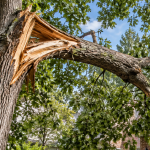
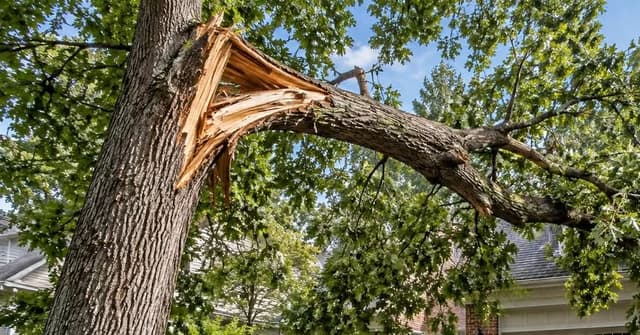
A broken tree limb hanging or lodged in the canopy should be treated as an urgent safety concern because it can shift or fall with little warning. Wind, rain, vibration, movement elsewhere in the tree, or continued failure at the attachment can change its position.
The potential consequences become more serious when the limb hangs above a house, driveway, vehicle, walkway, play area, or utility line. That does not mean every dead twig or firmly attached branch is an immediate emergency. Urgency depends on the limb’s size, condition, position, stability, and what it could strike.
If you find a suspended branch, keep people and pets away from the area. Do not stand underneath it, climb toward it, or attempt to pull it down.
What Is Considered a Hanging Tree Limb?
A hanging tree limb is a broken, cracked, or detached branch that remains suspended above the ground. It may still be connected to the tree or may be resting inside the surrounding canopy.
Several conditions can create a hanging-limb hazard:
- A broken branch held by bark or remaining wood fibers
- A detached branch lodged between other branches
- A cracked limb that has not completely separated
- A branch resting on another limb after a storm
- Deadwood with a weakened attachment
- A suspended branch caught against a structure or utility line
A limb may look stable from the ground because it has not moved for several hours or days. Its actual attachment can still be difficult to judge without a closer professional assessment conducted from a controlled position.
Deadwood that remains firmly attached is different from a fresh break hanging by bark. A small twig over an unused area is also different from a large limb suspended above an entrance. Each situation should be evaluated according to its actual exposure and condition.
Why Can a Hanging Limb Fall Without Warning?
A hanging limb can fall suddenly because the forces supporting it are already different from those of an intact branch. A small change in wind, moisture, weight, or canopy movement may be enough to dislodge it.
Rain can increase the weight of leaves and wet wood. High winds may twist the branch or move the supporting limbs. Snow or ice can add weight when winter conditions affect Northern Virginia and the Northern Neck.
Vibration can also matter. A vehicle, lawn mower, construction activity, or movement in another part of the tree may change how the branch rests. Decay and damaged wood fibers can continue to weaken after the initial break.
No one can reliably predict the exact moment a suspended branch will fall from a ground-level photograph. That uncertainty is why access below it should be restricted until the condition is assessed.
Which Hanging Limbs Present the Highest Risk?
The most urgent hanging limbs combine visible instability with meaningful exposure below them. A large branch over an occupied or frequently used area generally deserves faster attention than a small branch over an isolated section of land.
Higher-exposure locations include:
- A house, garage, roof, or outbuilding
- A driveway or parked vehicle
- A sidewalk, entrance, or frequently used path
- A deck, patio, or outdoor seating area
- A children’s play area
- A public or shared space
- An electrical or communication line
Position alone does not determine the level of urgency. Branch size, cracking, remaining attachment, movement, decay, weather exposure, and the amount of time people spend below it also matter.
Established neighborhoods may have mature trees close to homes, narrow driveways, and limited equipment access. Rural properties may have hanging limbs over barns, fences, long driveways, or access roads. The surrounding property helps determine how the area should be secured and how removal can be planned.
What Signs Suggest a Limb Could Fall Soon?
Fresh cracking, sudden sagging, exposed wood, and unusual movement can indicate that a limb has recently lost structural support. These signs justify keeping the area clear and requesting an assessment.
A limb hanging by strips of bark or wood fibers has already experienced significant failure. A completely detached branch caught between other limbs is also unstable, even if it appears wedged in place.
Other warning signs include splitting at the branch union, falling bark or wood fragments, and cracking sounds during calm or windy conditions. Damage may follow high winds, lightning, vehicle impact, or the failure of another branch.
Some defects cannot be seen clearly from the ground. Do not walk under the limb or move closer for a better view. Photographs taken from a safe distance may help explain the situation when contacting a tree service.
What Should You Do After Spotting a Hanging Limb?
The immediate priority is to prevent people, pets, and vehicles from entering the area below or near the limb. The branch should remain undisturbed until a qualified professional or utility representative can assess it.
Take these steps without approaching the hazard:
- Keep children, visitors, and pets away
- Block access to the affected walkway, driveway, patio, or yard section
- Move vehicles only when they can be reached without passing beneath the limb
- Avoid mowing, working, or standing under the affected canopy
- Contact a professional tree service for an assessment
- Contact the utility provider if electrical lines may be involved
- Call emergency authorities if there is an immediate threat to life or public safety
Do not shake the tree, throw objects at the branch, or pull it with a rope. Avoid ladders, chainsaws, pole tools, or equipment near the affected area.
For urgent situations involving storm damage, blocked access, or suspended limbs over occupied areas, our emergency tree service and storm cleanup page explains how Premier Tree & Landscaping handles emergency requests.
Why Should You Avoid Removing a Hanging Limb Yourself?
Hanging limbs should not be removed through improvised methods because they may contain hidden tension and move in an unexpected direction. A branch that appears light or loosely attached may be supporting more weight than it seems.
Pulling one end can release the branch, move other limbs, or cause multiple pieces to fall. The remaining attachment may also split further into the trunk or an adjoining branch.
Ladder use creates another risk because the worker may be standing within the branch’s fall path. Chainsaws and cutting tools add hazards when the wood shifts during contact.
The Occupational Safety and Health Administration identifies struck-by hazards, falls, and electrical exposure among the risks involved in professional tree-care work. A suspended limb can combine several of these hazards in one location.
What If the Limb Is Touching a Power Line?
If a limb is touching or near a damaged electrical line, assume the line and nearby materials may be energized. Stay well away, prevent others from approaching, and contact the utility provider.
Do not touch the tree, branch, fence, vehicle, or other object connected to the affected area. Do not attempt to identify the voltage, test the line, or move the limb.
Dominion Energy’s downed power-line guidance directs the public to consider downed lines energized and dangerous. Utility coordination may be necessary before any tree work can begin.
Responsibility and work procedures can depend on the type and location of the line. Our guide to trees near power lines provides more information without encouraging property owners to approach electrical hazards.
Does a Hanging Limb Mean the Whole Tree Must Be Removed?
A hanging limb does not automatically mean the entire tree must be removed. In some cases, removing the damaged branch and completing appropriate pruning may reduce the immediate concern.
The rest of the tree still needs to be evaluated. Major trunk cracks, widespread decay, severe root instability, extensive canopy damage, or multiple failed limbs may change the recommendation.
A tree that has retained sound structure may be a candidate for targeted work. Our tree trimming and pruning services may be relevant when the damage is limited and the tree can reasonably remain.
Complete tree removal may be considered when the broader condition creates a level of risk that cannot be adequately reduced. That decision requires an on-site assessment rather than a diagnosis from one visible branch.
What Happens During a Professional Assessment?
A professional assessment examines both the suspended limb and the condition of the surrounding tree. The goal is to understand what failed, what remains unstable, and what could be affected during removal.
The evaluation may consider the limb’s size, position, remaining attachment, and how it is lodged. The trunk and nearby branches may be checked for cracks, decay, weak unions, or additional storm damage.
Root movement, saturated soil, and ground stability also matter. Heavy rain can soften the soil around a tree, and visible canopy damage may be only one part of the problem.
The assessment also accounts for nearby houses, vehicles, fences, utilities, and access routes. Equipment must reach the work area, and branches or debris must leave without passing through an unsafe or unsuitable route.
How Are Hanging Tree Limbs Removed Safely?
Professional crews select a removal method based on the limb, the tree, available access, and surrounding targets. No single method is appropriate for every suspended branch.
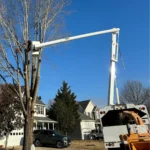
Depending on the site, the work may involve aerial access, controlled rigging, sectional removal, or crane-assisted equipment. The purpose is to control the branch and work area rather than allow unstable material to fall freely.
Premier Tree & Landscaping verifies equipment access and surrounding conditions before establishing a removal plan. We do not recommend a method until our team has evaluated the actual tree and property.
When Does a Storm-Damaged Limb Require Emergency Service?
Emergency service may be appropriate when a large or unstable limb is suspended over an occupied area, blocks safe access, rests on a structure, continues to move, or involves utility lines. These conditions require more immediate attention than damage over an isolated area with no current exposure.
High winds, severe thunderstorms, lightning, and heavy rain can break branches or weaken their attachments. Saturated soil may also affect the stability of the entire tree.
A damaged branch that remains attached away from people and structures may be suitable for scheduled evaluation. It should still be monitored from a safe location, especially if weather conditions are continuing.
Our team provides 24/7 emergency tree assistance throughout verified service areas in Northern Virginia and the Northern Neck. Calling does not require you to approach the tree or determine the removal method yourself.
What Should You Photograph for an Insurance Claim?
Photographs may help document storm damage when they can be taken without entering the affected area. Safety should take priority over obtaining a close-up image.
From a safe location, document the overall tree, hanging limb, surrounding property, and any visible structural damage. Wider photographs can show how the limb relates to the house, driveway, fence, vehicle, or other affected feature.
If visible, document the apparent cause of damage and the condition before material is moved. Keep copies of estimates, invoices, photographs, and removal documentation.
Coverage depends on the policy, circumstances, and insurer’s review. Contact your insurance provider for instructions specific to your claim, including whether additional documentation is needed before emergency work begins.
What Affects the Cost of Hanging Limb Removal?
The cost depends on the limb’s size, height, attachment, location, and the resources needed to control it. An assessment is generally necessary because photographs may not show access problems or hidden damage.
A limb over an open section of yard presents a different work zone from one above a roof, vehicle, narrow driveway, or utility line. Equipment access, rigging needs, debris volume, tree condition, and ground stability can all affect the scope.
Weather conditions may also limit access or increase the need for work-zone control. Emergency and scheduled projects can involve different planning requirements.
A clear estimate should explain the proposed work, debris handling, and whether additional pruning or tree removal is recommended. You can request an estimate after securing the area.
What Happens After the Immediate Limb Is Removed?
The remaining tree should be evaluated after the hanging limb is removed. Resolving the visible hazard does not automatically confirm that the entire tree is stable.
The assessment may identify additional cracked branches, weakened unions, canopy imbalance, trunk damage, root movement, or other storm-related defects. Some problems may require pruning, monitoring, or a broader tree-risk evaluation.
A large branch failure can also change how wind moves through the canopy. Decisions about follow-up work should reflect the tree’s remaining structure rather than simply matching its previous shape.
Can Professional Trimming Prevent Future Hanging Limbs?
Appropriate trimming can reduce some preventable concerns by removing dead, damaged, or poorly attached branches before they fail. It cannot prevent all storm damage or guarantee that a tree will never lose a limb.
Pruning should support the tree’s structure and condition. Excessive thinning or topping can create new problems rather than improve stability.
Regular evaluations are especially useful for mature trees near homes, driveways, outbuildings, and frequently used spaces. They can identify visible concerns before severe weather places additional stress on weakened branches.
Request Hanging Limb Removal in Northern Virginia
A hanging limb should be evaluated promptly when it threatens people, structures, access areas, vehicles, or utility lines. Keep the area clear and let a qualified professional determine whether limb removal, additional pruning, or complete tree removal is appropriate.
Premier Tree & Landscaping serves verified communities throughout Northern Virginia and the Northern Neck of Virginia. We work on established residential properties, rural land, commercial sites, and other locations where trees stand close to buildings, roads, fences, or utilities.
To discuss a suspended or storm-damaged limb, contact Premier Tree & Landscaping or submit a request for an on-site assessment. Our team will evaluate the limb, the surrounding tree, property access, and nearby targets before recommending the next step.